
Ink & Algorithms
Network Fraud Detection: Stopping Synthetic Identity Rings
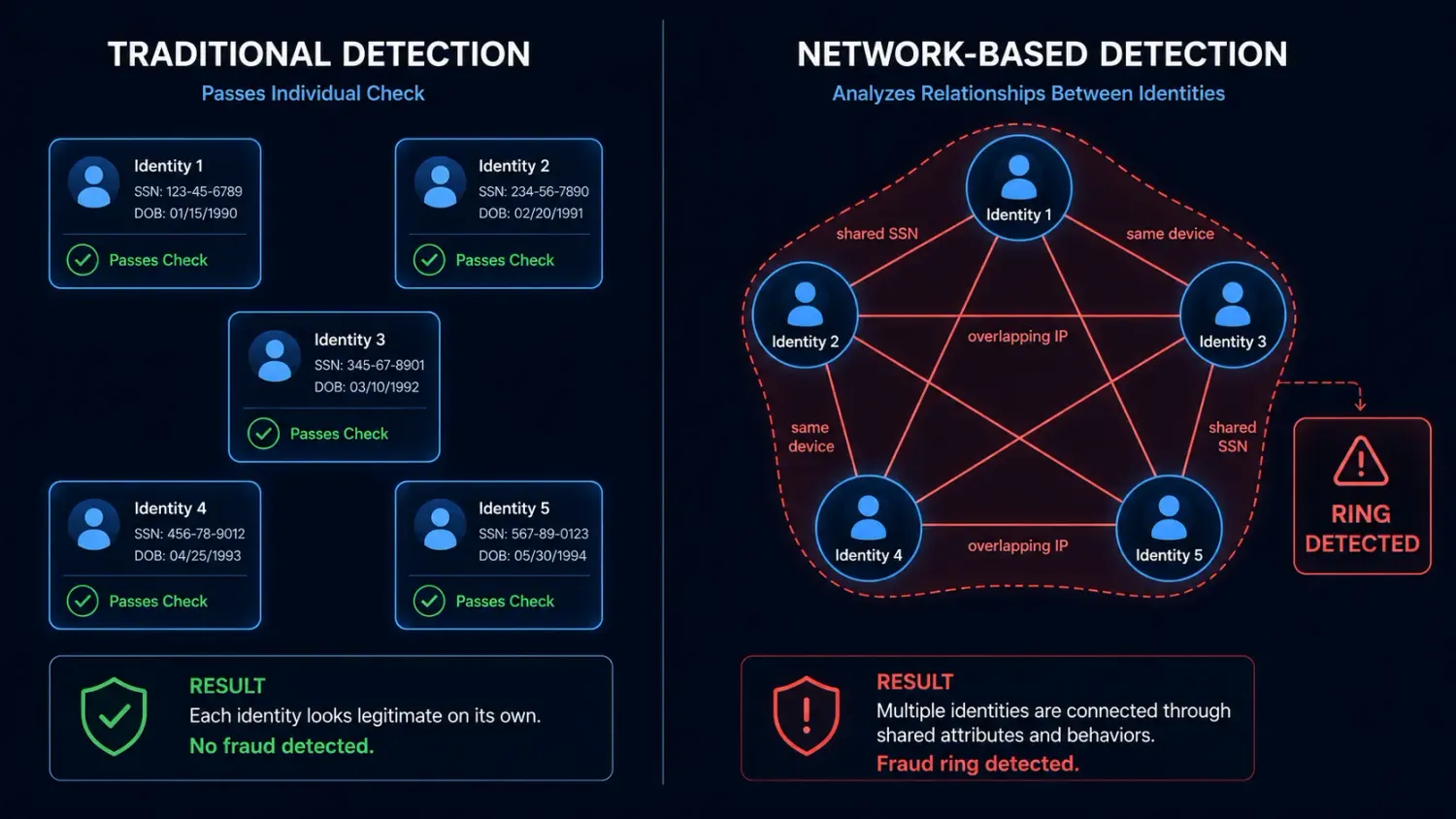
Picture a fraud ring with 200 members. Each synthetic identity has its own credit file, its own application history, a behavioral pattern that looks unremarkable on its own. Each one clears KYC. Each one passes bureau verification. Each one scores clean on your ML model.
Now run a graph query. Suddenly you can see that 200 accounts share three SSNs rotating across dozens of profiles. Their application timestamps cluster inside a 48-hour window. They route bust-out funds to the same six payment destinations. What your rule engine evaluated as 200 separate customers is one fraud operation - and it was always connected. You just weren't looking at it that way.
A network fraud detection system is a fraud prevention architecture that models entities (accounts, devices, IP addresses, phone numbers, transactions) as nodes and edges in a graph, then uses graph traversal algorithms or graph neural networks to detect coordinated fraud behavior that individual-account scoring cannot see.
Synthetic identity fraud generates over $6 billion in annual U.S. losses per Federal Reserve estimates and that number has moved in one direction. Generative AI is part of why. Assembling a synthetic identity - real SSN, plausible name, fabricated date of birth, synthetic address history - is no longer a specialized skill. It's a workflow. Fraud operations now generate profiles in bulk, test them against bureau APIs, iterate until they pass, and deploy rings of hundreds of synthetic identities that build credit in parallel and execute bust-out events in coordinated windows.
Legacy fraud tools weren't built for this. Rule-based systems score transactions. Isolated ML models score accounts. Fraud rings are organized at the network level, and they're deliberately engineered to keep each individual node below alert thresholds. The detection failure isn't a tuning problem - it's an architectural one.
What follows covers how graph-based fraud detection addresses that gap: why synthetic identity rings are invisible to point-in-time scoring, how shared infrastructure signals expose coordinated ring behavior, where real-time streaming and cross-institution data change the detection window, and what actually matters when you're evaluating a network fraud detection system for production.
🎭 What is Synthetic Identity Fraud - and Why Traditional Detection Fails?
Synthetic identity fraud is the deliberate construction of a fictitious person using a blend of real and fabricated personally identifiable information (PII) - typically a legitimate Social Security Number paired with an invented name, date of birth, and address - to create a credit-worthy identity that has no corresponding victim. It is the fastest-growing financial crime in the United States, accounting for an estimated 80–85% of all identity fraud losses and costing lenders over $6 billion annually [Federal Reserve].
Unlike stolen identity fraud, where a real person eventually notices unauthorized activity and files a dispute, synthetic identity fraud has no victim to trigger an alert. The "person" who borrowed $40,000 in credit doesn't exist - which means no fraud report, no dispute, no chargeback signal. The first time a lender realizes something is wrong is usually when the account stops making payments and vanishes.
🕵️♂️ How fraudsters build synthetic identities?
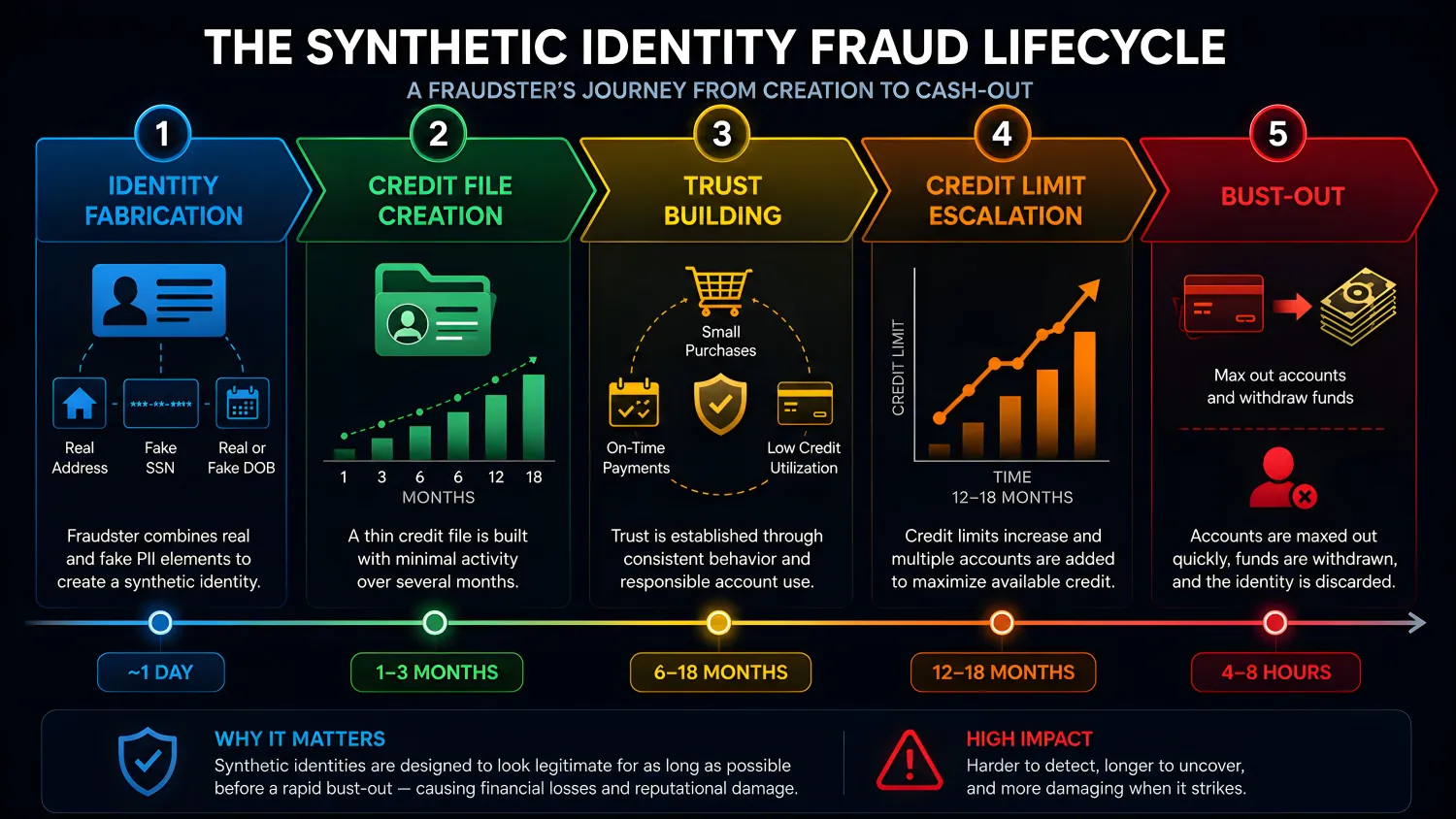
The process is methodical and, at this point, well-documented in fraud operations circles. It runs in five stages:
1. SSN sourcing
Fraudsters target Social Security Numbers with thin or nonexistent credit histories: children, recent immigrants, deceased individuals, people who have never engaged with the U.S. credit system. Since the SSA moved to randomized SSN assignment in 2011, valid-but-dormant numbers have become easier to identify programmatically - some operations test SSNs against bureau APIs in bulk to find ones that return no file
2. Profile assembly
The real SSN gets a fabricated identity built around it: a name that sounds plausible, a date of birth that makes the profile age-eligible for credit, and a synthetic address - usually a real street address with a modified unit number that passes USPS address validation without connecting to any existing resident.
3. Credit file seeding
A brand-new synthetic identity has no credit file, so fraudsters create one. Two methods dominate: adding the synthetic profile as an authorized user on a legitimate cardholder's account (instantly inheriting that account's positive payment history), or opening secured credit cards, which have lower verification thresholds by design.
4. Profile nurturing - the phase that breaks most models
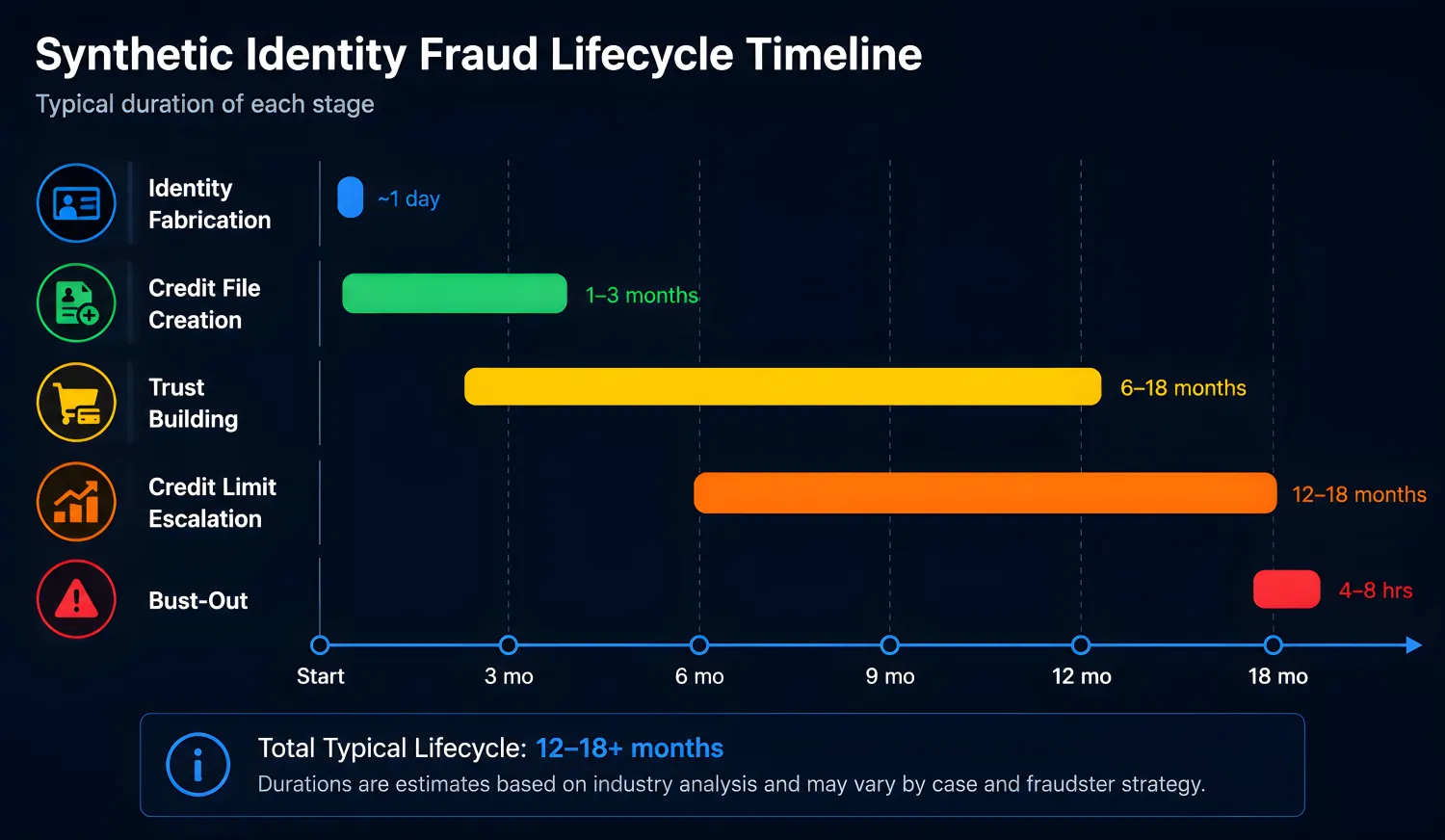
For 12 to 24 months, the synthetic identity behaves well. Small purchases. On-time payments. Gradual limit increases. To any individual risk model, this looks like a recovering borrower or a credit newcomer building history. The ML score drops. The account gets treated as low risk.
5. Bust-out
Once credit limits are maximized across multiple accounts, the ring moves fast - maximum cash advances, balance transfers, high-value purchases, all inside a 24 to 72-hour window. Then silence. By the time the accounts classify as fraud rather than default, the funds are gone and the identities are abandoned.
🧱 Why Rule-Based Systems Miss Synthetic Rings?
The detection gap isn't a tuning problem. It's structural.
Rule-based fraud systems evaluate transactions and accounts against static conditions - velocity limits, address mismatches, device signals. Every synthetic identity in a ring is built to pass those checks independently. No stolen card number to blocklist. No address that fails CASS validation. No velocity trigger because the fraudster waited 18 months before moving.
The deeper problem is siloed evaluation. A ring running 200 synthetic identities across four lenders shows each institution 50 accounts that look like ordinary thin-file borrowers. None of those institutions can see that the same device fingerprint appears across 60 applications, that a cluster of those applications hit in a 6-hour window from the same IP subnet, or that three SSNs are cycling across all 50 accounts they hold. That pattern only exists in aggregate - and rule engines don't aggregate.
| Detection Method | What It Scores | Sees Ring Coordination? |
Why It Misses |
|---|---|---|---|
| Rule-based engine | Individual transaction | No | Rules are account-scoped, not graph-scoped. |
| Threshold ML model | Individual account | No | Trained on account-level features; blind to graph structure. |
| Bureau-based verification | Identity elements in isolation | No | Each SSN/name combination can be individually valid. |
| Network fraud detection | Entity relationships across accounts | Yes | Models connections, not just attributes. |
A few specific gaps make synthetic rings particularly hard to catch with legacy tools:
No victim signal: Stolen identity fraud generates disputes that feed back into fraud models. Synthetic identity fraud generates nothing - until accounts charge off, which happens 90+ days post-bust-out, well outside any useful detection window.
Deliberate threshold calibration: Rings study which behaviors trigger reviews and keep synthetic identity activity below those lines. The nurturing phase isn't just patience - it's actively generating clean behavioral history to suppress risk scores.
Bureau verification by design passes them: Bureau KYC checks confirm that a name-SSN-DOB combination is internally consistent with bureau records. A synthetic identity with a seeded credit file is internally consistent by construction.
Cross-institution invisibility: Each institution holds a fragment. The coordinated pattern - shared devices, synchronized application timing, rotating PII - is only visible when data crosses institutional lines. Most fraud stacks don't cross those lines.
Catching synthetic identity rings means building detection that was designed for networks from the start - not point-in-time scoring with a graph layer bolted on later.
🕸️ What is a Network-Based Fraud Detection System?
A network-based fraud detection system scores relationships between entities - accounts, devices, identities, and transactions - rather than evaluating each entity in isolation, surfacing coordinated fraud patterns that point-in-time ML models are architecturally blind to.
Traditional ML fraud models work from feature vectors: a snapshot of an account's attributes and transaction history at a single moment. They answer "how risky is this account right now?" Network-based detection asks something different: "what does the company this account keeps tell us?" In practice, that's the gap between a model that scores 200 synthetic identities as 200 separate low-risk accounts and one that reads them as a single connected operation.
📐 Core Architecture - The Fraud Graph
The foundation of any network fraud detection system is a property graph: a data structure where entities become nodes and the relationships between them become edges. In financial fraud contexts, the graph models:
Nodes (entities):
Customer accounts and loan applications
Devices (mobile hardware IDs, browser fingerprints, emulator signatures)
Identity elements (SSNs, phone numbers, email addresses, physical addresses)
IP addresses and network identifiers
Merchant accounts and payment destinations
Edges (relationships):
Transactions between accounts and merchants
Shared PII attributes (two accounts tied to the same phone number)
Behavioral co-occurrence (two applications submitted from the same device within a time window)
Authorized user relationships (account A added account B as an authorized user)
The schema depends on what you're defending against. Two architectures handle different threat surfaces:
| Graph Type | Primary Nodes | Primary Edges | Best For |
|---|---|---|---|
| Identity graph | Accounts, SSNs, devices, addresses, emails | Shared PII, device linkage, application co-occurrence | Synthetic identity fraud, application fraud, account opening |
| Transaction graph | Accounts, merchants, payment rails | Fund flows, transfer chains, velocity patterns | Money laundering, bust-out detection, P2P fraud |
Most production fraud stacks run both and query them in combination - the identity graph surfaces a ring at onboarding; the transaction graph tracks fund movement during and after bust-out.
🔎 How Graph Traversal Exposes Rings?
Most production fraud stacks run both and query them in combination - the identity graph surfaces a ring at onboarding; the transaction graph tracks fund movement during and after bust-out.
🔗 Community detection
Community detection algorithms partition a graph into clusters of densely interconnected nodes. In fraud contexts, a cluster of accounts sharing devices, addresses, or application timing - with no plausible legitimate reason to be linked - is a candidate ring.
Two algorithms appear most often in production:
Louvain method: Optimizes modularity across the full graph to find natural communities. Fast on large graphs; well-suited for offline ring identification and periodic risk rescoring of existing account portfolios.
Label propagation: Each node inherits the most frequent label among its neighbors, iterating to convergence. Lower compute cost than Louvain; better for near-real-time partitioning as new accounts join the graph.
Neither algorithm inherently knows what fraud looks like - they identify structure. The fraud signal comes from seeding the graph with confirmed fraud nodes: if two known fraud accounts share a cluster with 15 others, those 15 accounts are immediate review candidates regardless of their individual risk scores.
🗺️ Pathfinding
Pathfinding queries trace the shortest connection between two entities. For synthetic identity detection, the value is in surfacing accounts that share no direct attribute but are linked through intermediate nodes.
A practical example: Account A and Account B share no PII. But Account A was opened from Device X, and Device X was also used to open Account C, which shares a phone number with Account B. That's a two-hop path connecting A to B. A rule engine won't find it. An account-level ML model won't find it. A graph query resolves it in milliseconds.
// Neo4j Cypher: Find accounts within 2 hops of a confirmed fraud node

MATCH path = (fraud:Account {status: 'confirmed_fraud'})-[*1..2]-(candidate:Account)

WHERE candidate.status <> 'confirmed_fraud'

RETURN
    candidate.account_id,
    length(path) AS hop_distance,
    [node IN nodes(path) | labels(node)] AS connection_path

ORDER BY hop_distance ASC

LIMIT 100
This returns candidate accounts connected to confirmed fraud within two hops, along with the full connection path - useful for analyst review queues and SAR narrative preparation.
🎯 Centrality measures
Centrality measures quantify how structurally important a given node is within the graph. In ring investigation, they help separate orchestrators from periphery accounts.
Degree centrality counts direct connections: A legitimate SSN appears on one or two accounts. One linked to 40 accounts is either orchestration infrastructure or confirmed fraud - degree centrality surfaces it immediately.
Betweenness centrality identifies nodes that sit on the most paths between other nodes: In a fraud ring, the orchestrator's device or a shared address often shows high betweenness: it's the connective tissue linking otherwise separate sub-clusters.
Fraud propagation (adapted PageRank) spreads risk scores outward from confirmed fraud nodes through the graph, weighted by edge type and hop distance. A shared SSN edge propagates more risk than a shared IP edge; a direct transaction edge more than behavioral co-occurrence.
Run together, these produce a workable ring map: orchestrators near the center with high betweenness and degree, mule accounts at the periphery with elevated propagated risk but lower structural centrality, and shared infrastructure - devices, addresses, SSNs - visible as high-centrality connector nodes between sub-clusters.
Graph-based approaches consistently outperform rule-based systems in coordinated fraud benchmarks. Research published in IEEE Transactions on Neural Networks and Learning Systems (IEEE 2024/2025) has reported precision improvements of 15-30% over traditional methods on financial fraud graph datasets, with production deployments at major card networks identifying rings that existing rule stacks had missed for more than 12 months.
🚦 Five Signals That Reveal a Synthetic Identity Ring (Before Bust-Out)
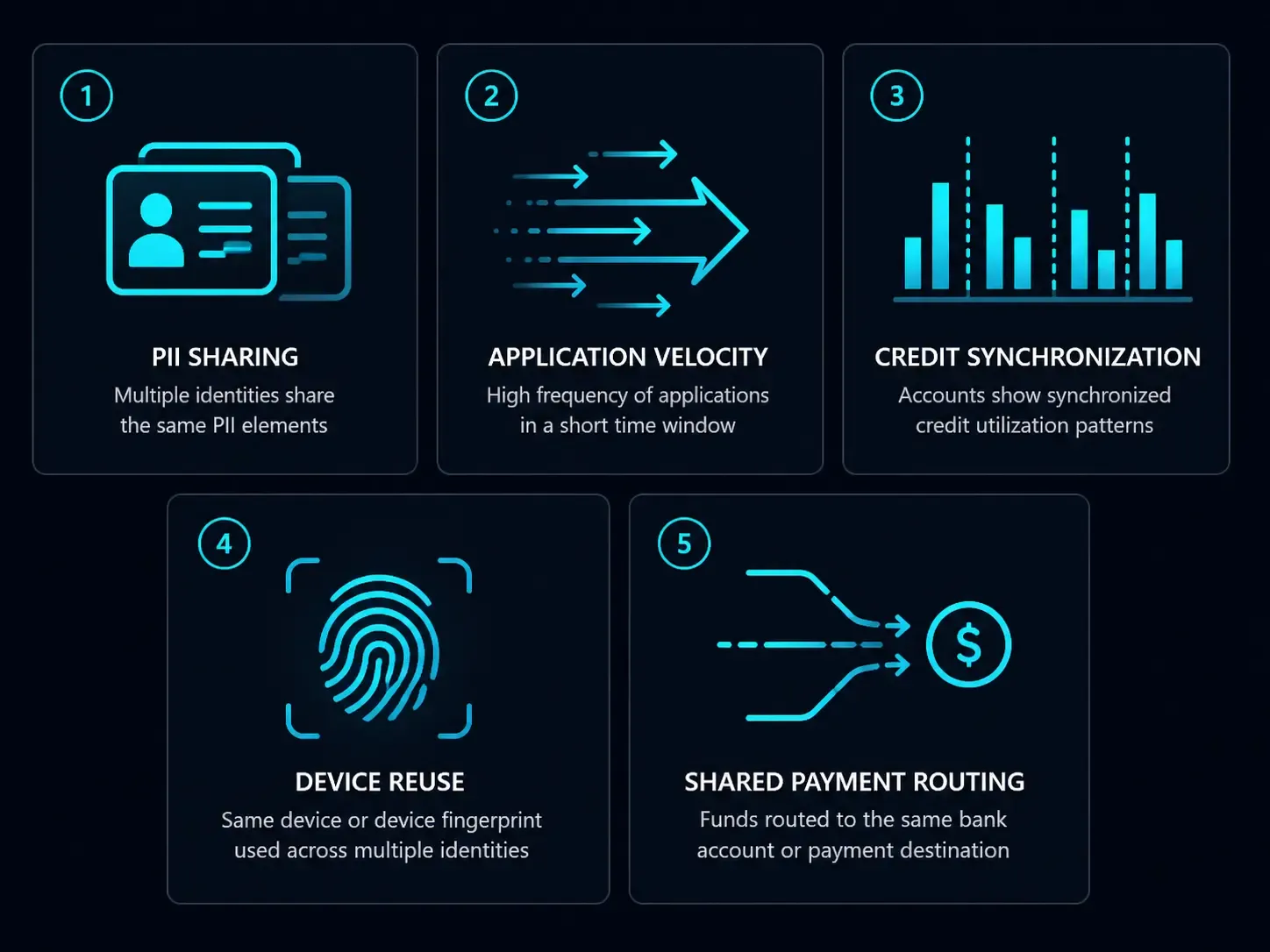
Fraud rings don't fail because one identity makes a mistake. They fail because running a ring of 50 or 200 synthetic identities requires shared infrastructure - and that infrastructure leaves traces that accumulate across accounts in ways that individual behavior never would.
Sophisticated rings keep each identity's individual behavior clean. What they can't fully hide is the scaffolding: the device that opened 30 accounts, the SSN cycling across 15 applications, the payment destination that receives bust-out funds from accounts with no apparent relationship to each other. These are the patterns network fraud detection reads.
1. PII attribute sharing
The same Social Security Number, phone number, or mailing address appears across multiple distinct applicant profiles. In a legitimate portfolio, a single SSN appears on one or two accounts. When that SSN surfaces on 12 or 40 applications under different names and dates of birth, the false positive rate at that scale is near zero. Phone number reuse is subtler - rings sometimes rotate a small pool of real numbers across applications to pass SMS verification, creating linkage that only becomes visible in aggregate.
2. Correlated application velocity
Clusters of new applications arrive within compressed windows - hours rather than days - originating from the same device, IP subnet, or ASN. Legitimate customers don't apply for 30 credit accounts in 18 hours from the same IP block. Fraud operations do, particularly when running automated submission scripts that batch-process profiles as fast as institution rate limits allow. Velocity signals get meaningfully stronger when correlated with device or network signals rather than evaluated on time alone.
3. Synchronized credit utilization patterns
Accounts within a ring ramp credit limits in near-identical behavioral sequences - same purchase categories, similar transaction amounts, comparable payment timing. The synchronization is a consequence of operational management: the same controllers running the same playbook across all synthetic identities in the portfolio. The pattern is rarely perfect, but statistical clustering of utilization curves across a flagged account cohort is a reliable ring signal, especially when combined with graph community membership.
4. Device fingerprint reuse
The same hardware configuration, browser fingerprint, or mobile device ID appears across multiple applications or login sessions. A device fingerprint combines dozens of attributes - OS version, screen resolution, installed fonts, WebGL renderer, battery status API output, network timing - into a near-unique identifier. Fraudsters who rotate identities but reuse devices leave a persistent hard link between accounts. Even rings that use device farms or emulators to simulate unique devices produce fingerprint populations that cluster differently from genuine consumer devices.
5. Shared payment destinations
Bust-out funds from accounts with no apparent connection route to the same merchants, peer payment accounts, or external transfer destinations. This signal appears at the end of the lifecycle rather than at onboarding, but it's valuable for retroactive ring reconstruction and generates labeled fraud data that feeds back into graph models. When 30 unrelated-looking accounts cash out to three cryptocurrency exchange deposit addresses or the same prepaid card BINs inside a 48-hour window, the ring's exit infrastructure becomes visible.
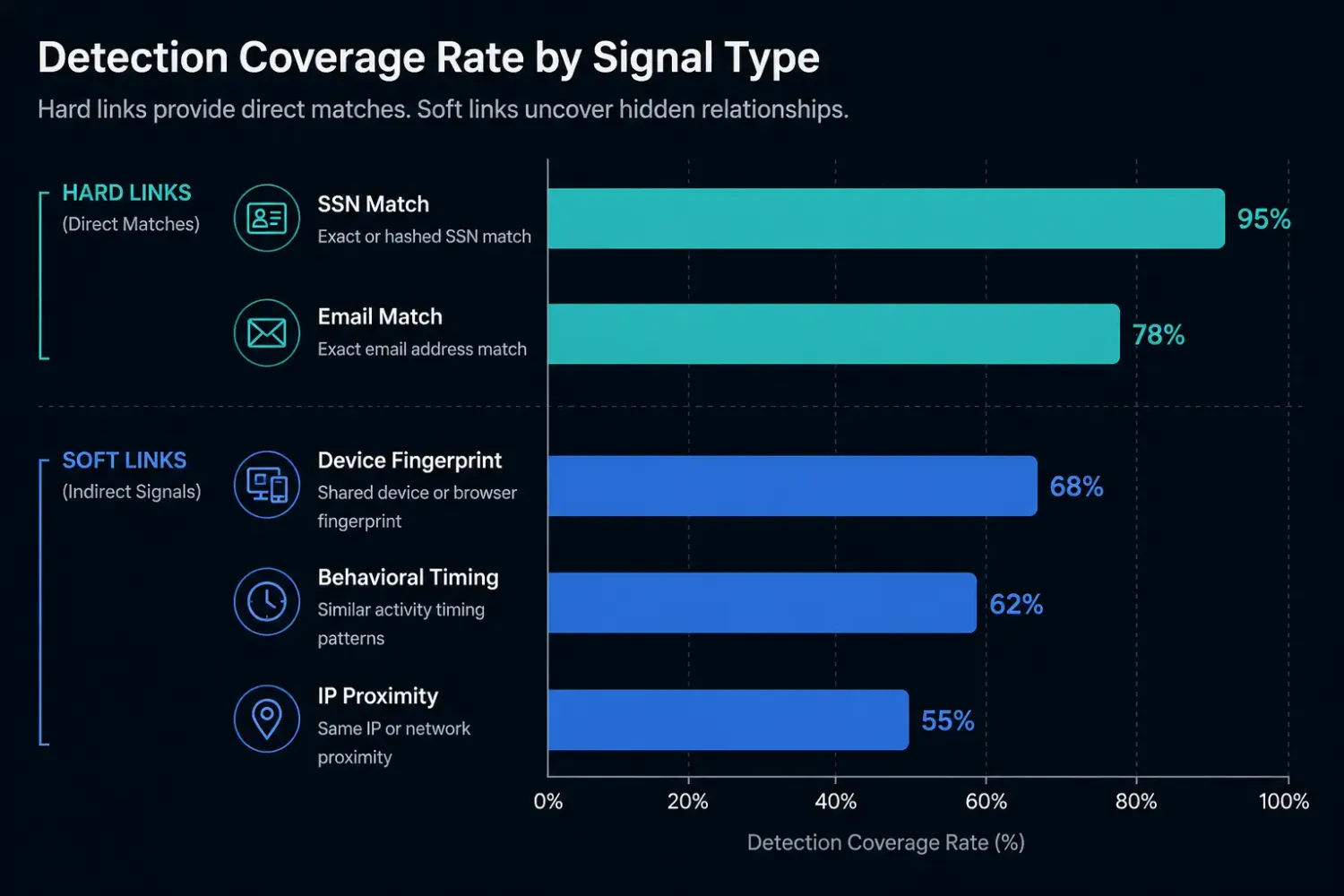
🆚 Hard Links vs. Soft Links - and Why the Distinction Matters
These five signals don't all carry the same evasion resistance, and where a fraud stack sits on that spectrum determines how much of the ring population it actually catches.
Hard links are exact matches on shared identity attributes:
Same SSN across multiple applications
Same email address used across distinct profiles
Same phone number used for OTP verification on multiple accounts
Same physical address tied to multiple applicants
Hard links have a strong signal-to-noise ratio when they appear - an SSN on 15 accounts is almost always fraud - but they're straightforward for sophisticated rings to route around. At scale, operations generate unique emails programmatically, use address permutations to defeat exact-match deduplication, and purchase SIM pools for phone verification. Hard links are caught by basic deduplication rules; they don't require a graph.
Soft links are probabilistic connections from behavioral, device, and network signals:
Device fingerprint overlap or clustering (not exact match, but statistically similar configurations)
Application timing correlation (submissions within the same narrow window from similar network characteristics)
IP proximity (same subnet, same ASN, same datacenter egress point)
Behavioral sequence similarity (credit ramp curves that cluster statistically across accounts)
Session telemetry patterns (navigation timing, tap dynamics, scrolling behavior on mobile)
Soft links are harder to manufacture around. A ring can generate unique emails; it cannot cheaply make 200 devices look statistically indistinguishable from 200 real consumer devices. Behavioral timing is harder still - the latency characteristics of automated application scripts differ from human sessions in ways that survive most obfuscation attempts.
| Link Type | Examples | Evasion Difficulty | Detection Requirement |
|---|---|---|---|
| Hard | Shared SSN, email, phone, address | Low – easily rotated at scale | Basic deduplication; rule engine |
| Soft | Device fingerprint, session timing, IP proximity, behavioral curves | High – expensive or impossible to fully mask | Graph analysis; ML clustering; behavioral biometrics |
Research on financial fraud ring datasets suggests hard-link-only detection captures a minority of ring members at application time, because sophisticated operations have largely engineered hard-link exposure out of their onboarding workflow. Soft-link detection - device intelligence fused with behavioral biometrics and application timing correlation - surfaces ring connections that PII data alone doesn't show.
For fraud product managers evaluating vendors, the right question isn't "do you detect shared SSNs?" - any rule engine does. The more useful questions: What soft-link signals do you capture? How do you weight them in the graph? What's your false positive rate on soft-link-only ring flags?
⚔️ Graph Neural Networks vs. Rule-Based Fraud Detection - A Technical
Comparison
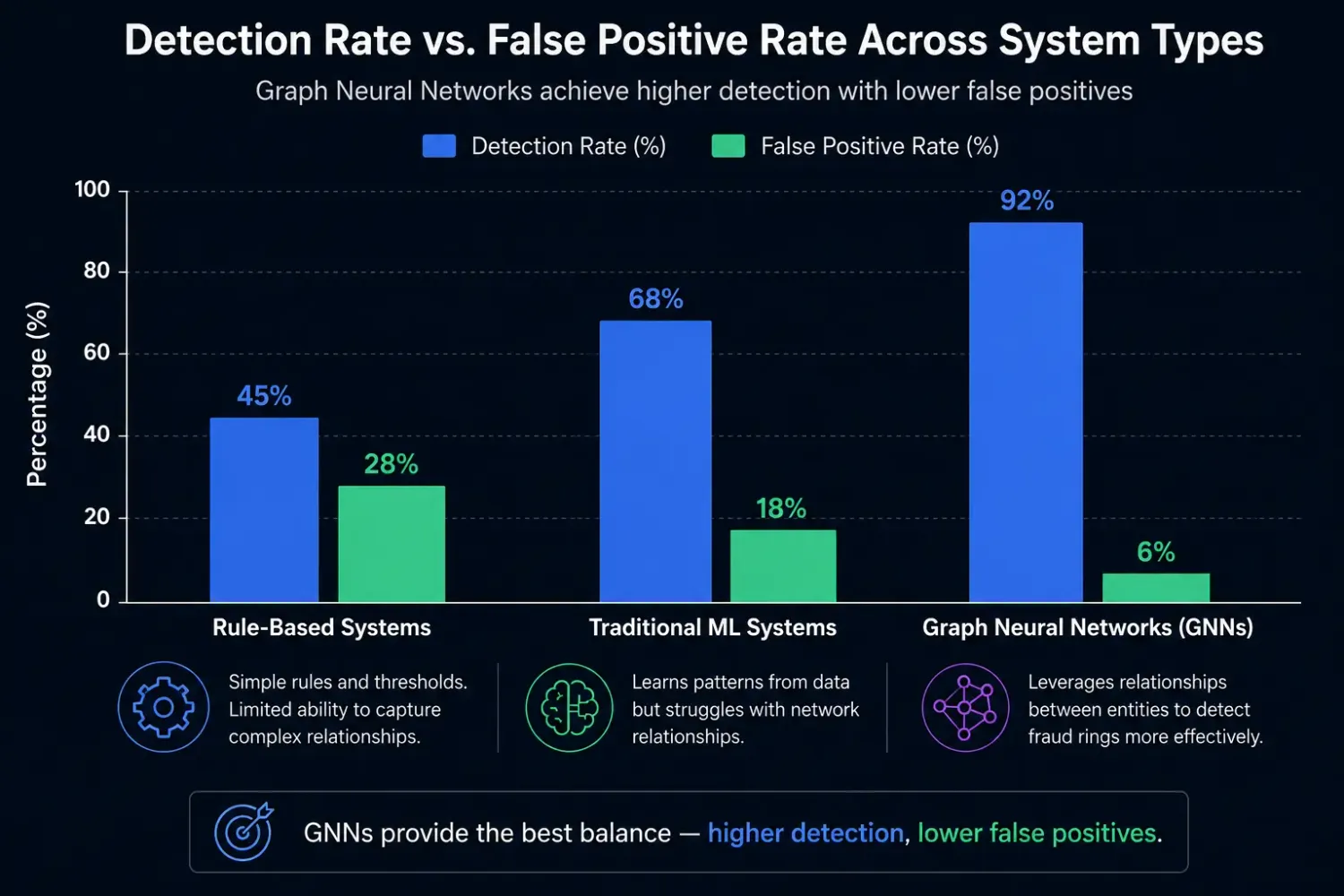
Rule-based fraud systems catch fraud that has already been profiled. A rule fires when a known pattern repeats — same card, same merchant category, same velocity signature. Graph Neural Networks work from a different premise: they learn structural relationships across an entity graph and generalize from those relationships to score patterns they've never seen labeled. For synthetic identity ring detection, that difference in premise is where the detection gap lives.
🕸️ How GNNs Work in Fraud Contexts?
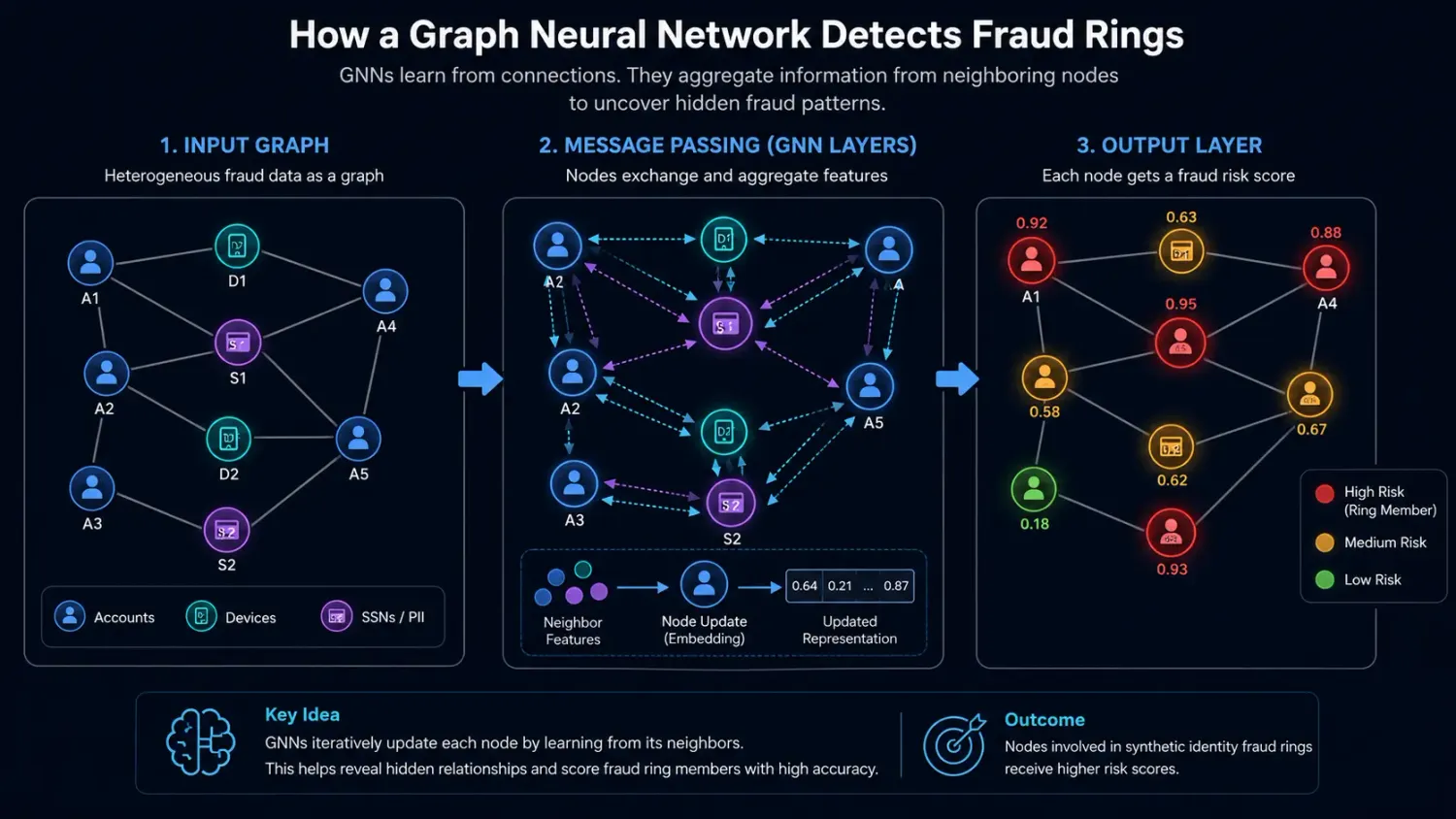
A Graph Neural Network treats the fraud graph as its input and produces risk scores as output, with the scoring logic driven by learned representations of how nodes relate to their neighbors - not by hand-written thresholds.
The scoring process runs in three stages:
Node feature initialization: Each entity in the graph starts with a feature vector - a structured representation of its known attributes.
For an account node, that might include:
Account age (days since opening)
Transaction velocity (transactions per day over a rolling 30-day window)
Device type association (mobile vs. desktop, emulator flag)
SSN vintage (estimated age of the SSN based on issuance range)
Credit utilization trajectory (slope of balance-to-limit ratio over 90 days)
Application channel (in-branch, online, API/partner)
For a device node, feature vectors capture fingerprint stability, emulator probability score, and the count of distinct accounts linked to that device. Identity element nodes (SSN, phone, email) carry features like link count, age of first appearance in the graph, and bureau-data consistency score.
Edge feature aggregation - message passing: Each node updates its representation by aggregating the feature vectors of its neighbors, weighted by edge type and learned attention scores.
A GraphSAGE or Graph Attention Network (GAT) layer does this iteratively: after one message-passing round, each node has incorporated information from its direct neighbors; after two rounds, from two-hop neighbors; and so on.
In practice for fraud ring detection, two to three message-passing rounds are standard. Beyond three hops, the aggregation tends to over-smooth - legitimate and fraud nodes converge toward similar representations as the neighborhood window expands to include the broader graph population.
# Simplified PyTorch Geometric: 2-layer GraphSAGE for fraud ring scoring

import torch
from torch_geometric.nn import SAGEConv
import torch.nn.functional as F

class FraudRingGNN(torch.nn.Module):

    def __init__(self, in_channels, hidden_channels, out_channels):
        super().__init__()
        self.conv1 = SAGEConv(in_channels, hidden_channels)
        self.conv2 = SAGEConv(hidden_channels, out_channels)

    def forward(self, x, edge_index):

        # Round 1: aggregate 1-hop neighbor features
        x = self.conv1(x, edge_index)
        x = F.relu(x)
        x = F.dropout(x, p=0.3, training=self.training)

        # Round 2: aggregate 2-hop neighbor features
        x = self.conv2(x, edge_index)

        return torch.sigmoid(x)  # Output: per-node fraud probability [0, 1]
Supervised vs. semi-supervised training: Labeled fraud data in financial services is scarce and delayed - charge-offs that confirm synthetic identity fraud typically surface 60 to 90 days after bust-out, by which time the ring has already exited. Two training approaches handle this:
Supervised GNN: Trained on a labeled dataset of confirmed fraud and confirmed legitimate accounts. Requires sufficient labeled nodes (typically 1–5% of the graph) to generalize. Higher precision but slow to adapt to novel ring structures not present in training data.
Semi-supervised GNN: Uses a small labeled seed set and propagates labels across the graph structure, with unlabeled nodes contributing to the loss function through graph regularization. Better suited to the sparse labeling reality of fraud operations - and better at surfacing ring members connected to only one or two confirmed fraud nodes.
Most production deployments use a hybrid: supervised pretraining on historical labeled data, with semi-supervised fine-tuning as new fraud confirmations arrive.
🆚 Comparison: Rule-Based Systems vs. Traditional ML vs. Graph Neural Networks
| Dimension | Rule-Based Engine | Traditional ML (XGBoost) | Graph Neural Network |
|---|---|---|---|
| Unit of analysis | Individual transaction | Individual account | Network of entities |
| Ring detection | ✗ Blind to coordination | ✗ Misses graph structure | ✓ Native ring awareness |
| Feature scope | Static thresholds | Account-level features | Node + edge + neighborhood features |
| Adaptability | Manual rule updates | Periodic retraining | Continuous graph updates |
| False positive rate | High (broad rules) | Moderate | Lower (relationship context reduces noise) |
| Explainability | High - rule fired, reason logged | Moderate - SHAP values | Requires attention layers or GNNExplainer |
| Cold-start performance | Strong - rules apply immediately | Moderate | Weak - sparse graphs degrade performance |
| Latency | <10 ms | <50 ms | 50–500 ms (batch inference faster) |
| Implementation complexity | Low | Moderate | High |
| Labeled data requirement | None | Moderate (thousands of examples) | Significant (thousands to hundreds of thousands) |
⚠️ Limitations of GNNs in Production Fraud Stacks
GNNs outperform rule-based systems on coordinated fraud detection benchmarks (Visa/HSBC GNN performance data). Production deployment introduces four constraints that tend to arrive as surprises.
Cold-start problem at onboarding: A GNN learns from graph structure. A new account with no transaction history, no device linkage history, and no neighboring nodes with established features produces a near-uninformative node vector. At the moment of highest fraud risk - the application - the graph is sparsest. Most teams address this with a hybrid scoring approach: rule-based or traditional ML scoring at onboarding, with GNN scores applied progressively as the graph populates around a new node.
Computational cost at transaction scale: Real-time graph traversal across a fraud graph with tens of millions of nodes and hundreds of millions of edges is expensive. Message-passing inference for a single node requires reading and aggregating neighbor feature vectors - which means graph database query latency stacks with model inference time. Teams handling high-throughput payment rails (>10,000 transactions per second) typically solve this through precomputed node embeddings refreshed on a near-real-time schedule, rather than running full graph inference per transaction.
Labeled ground truth delay: Synthetic identity fraud labels arrive late. An account that busts out in March may not be confirmed as fraud until June - three months of account activity that could have trained the model are unlabeled during the highest-signal period. Active learning pipelines that prioritize human review of high-uncertainty graph nodes can compress this window, but the delay is a structural constraint of credit fraud operations rather than a model problem.
Adversarial graph poisoning: Sophisticated fraud operations study detection patterns and adapt. In a graph context, this can take the form of deliberate noise injection: adding legitimate-looking connections between synthetic and real accounts, or structuring ring communication through intermediary accounts with clean behavioral histories to increase the hop distance between fraud nodes. Academic research on adversarial robustness in GNNs shows that targeted poisoning attacks can meaningfully degrade community detection performance - a consideration for large-scale fraud operations with sufficient resources to probe detection logic.
For fraud teams: GNNs deliver a real detection improvement over rule-based baselines, but they work best as one layer in a multi-signal stack. A GNN without rules, traditional ML, and a human review queue behind it isn't a fraud system - it's a research experiment.
⏱️ Real-Time Fraud Signals - How Speed Changes the Detection Equation
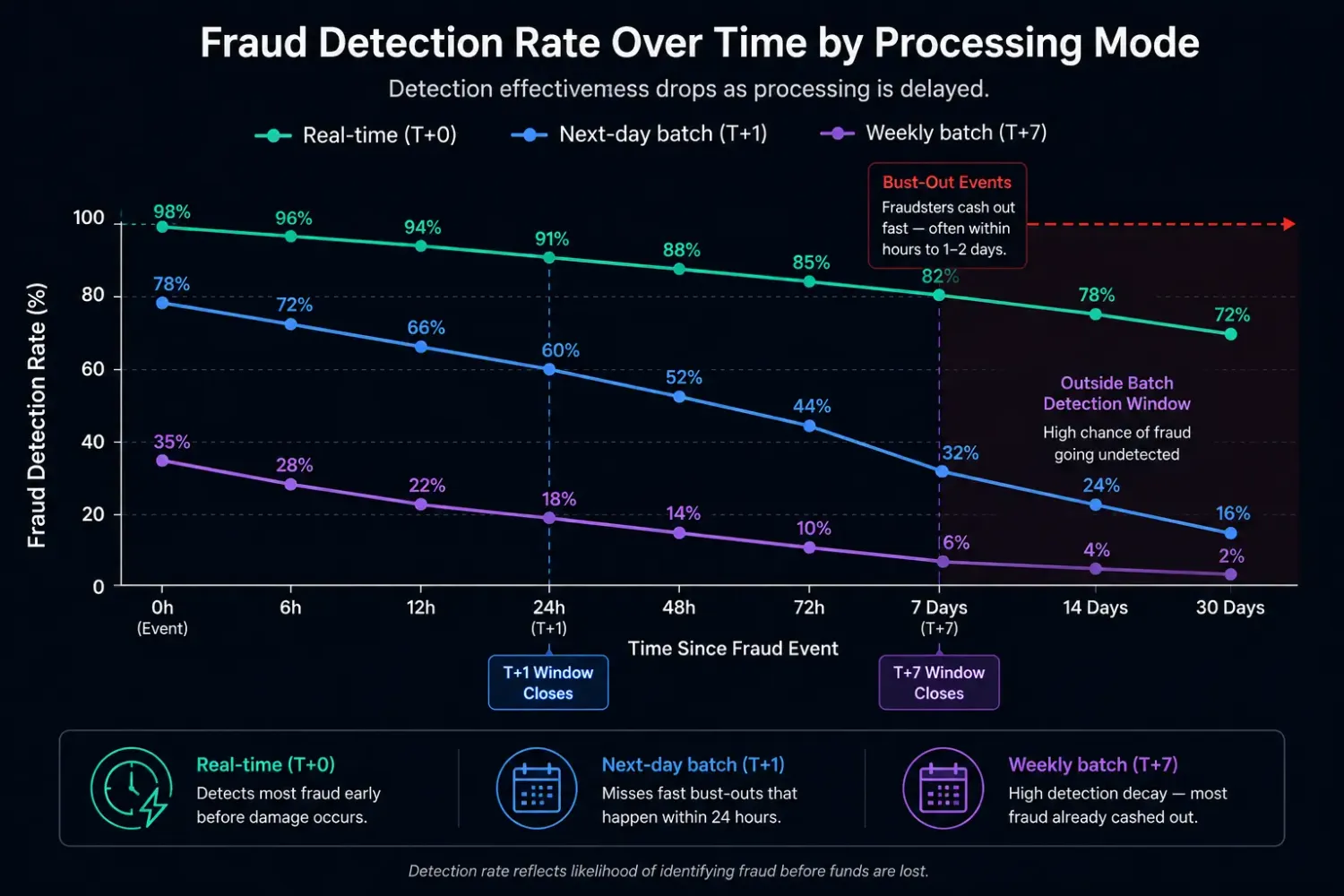
A graph-based fraud detection system is only as effective as the speed at which its graph state reflects reality. An entity graph that updates nightly misses the bust-out window entirely - because synthetic identity rings don't wait for your batch job to run.
The bust-out pattern is time-compressed by design. Once a ring executes, cash advances, balance transfers, and high-value purchases hit in a coordinated burst. Industry data on bust-out recovery rates consistently points to a 4 to 8-hour window between initial drawdown and fund exit - the point at which money has moved through enough intermediary accounts to become practically unrecoverable. A batch scoring system that processes accounts at T+1 or T+7 doesn't detect the ring; it documents it after the loss has settled.
⚡️ Streaming Graph Updates vs. Batch Processing
Real-time network fraud detection requires an event-driven architecture in which every fraud-relevant signal updates the graph state immediately on occurrence - not on a scheduled processing cycle.
The standard infrastructure pattern uses a message streaming layer as the backbone:
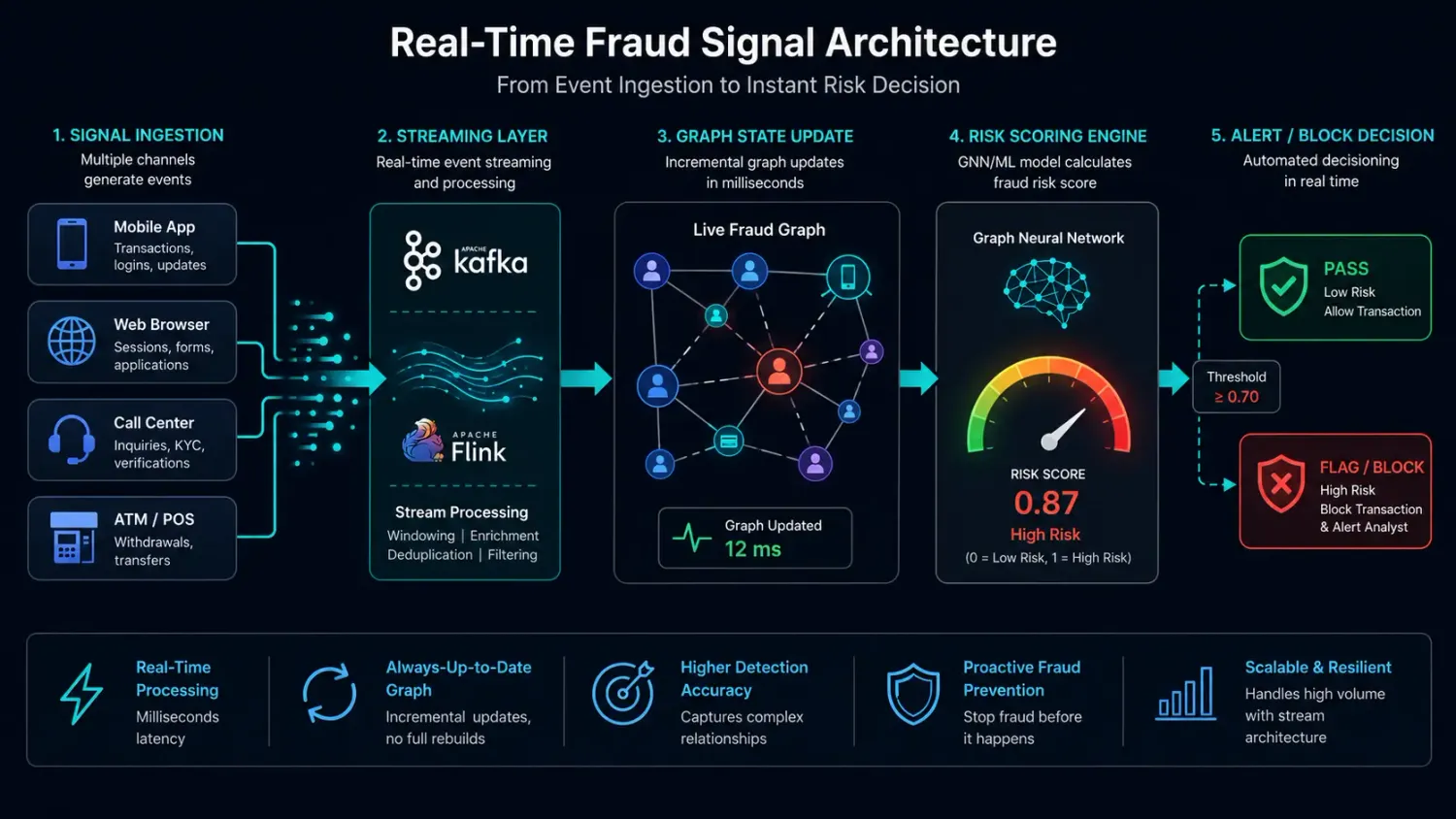
The Kafka layer partitions events by entity ID - account, device, SSN - so all events related to a single entity land on the same consumer partition and can be processed in order without distributed locking overhead. Flink handles stateful computation: rolling velocity windows, device fingerprint matching against the graph's existing device nodes, and PII linkage resolution that fires when a new application shares an attribute with an existing account.
The critical design decision is where graph state updates sit relative to scoring. Two approaches:
| Architecture | Graph Update Timing | Scoring Latency | Bust-Out Coverage |
|---|---|---|---|
| Synchronous update | Graph updated before score returned | 200–800 ms | Full – score reflects current graph state |
| Async update + precomputed embeddings | Graph updated in parallel; score uses last embedding | <50 ms | Partial – misses edges created in the last embedding refresh cycle |
| Batch graph rebuild | Graph rebuilt on schedule (hourly/nightly) | <10 ms | Poor – detection window expires before graph reflects bust-out activity |
Most high-throughput fraud stacks at card issuers and major fintechs use async update with embedding refresh cycles measured in seconds to low minutes - not hours. The specific refresh interval is the tunable parameter that determines how much of the bust-out window your graph can actually see.
The device fingerprint match is where millisecond-level processing pays off most directly. When a new transaction arrives, a Flink operator resolves the device fingerprint against the graph's device node index in under 10ms, checks whether that device is connected to any flagged accounts, and either passes the transaction or triggers a graph query for deeper ring analysis - all before the authorization response window closes.
🚨 The Role of Behavioral Signals in Real-Time Detection
Device fingerprint and PII linkage are graph signals - they surface ring structure. Behavioral signals operate differently: they detect anomalies within a single session or account that indicate the account is being operated inconsistently with its established history. In a real-time fraud stack, both signal types run in parallel, and their combination is more powerful than either alone.
Session anomalies inconsistent with account age
A 24-month-old account with consistent mobile app usage that suddenly initiates a cash advance through the web interface at 2:47 AM using a new device in a different city is exhibiting three simultaneous anomalies. Each individual anomaly might pass. Together, they produce a behavioral risk score that warrants a hold or step-up authentication before authorization completes. The anomaly detection logic compares session attributes against a rolling behavioral baseline built from the account's last 90 days of activity - channel preference, session timing distribution, transaction category mix, geolocation patterns.
For synthetic identity ring accounts in the bust-out phase, the anomalies are structural rather than subtle. These accounts have thin, artificial behavioral histories - typically low-value recurring purchases that the ring controller ran to build the behavioral profile. When the bust-out triggers, the session behavior immediately diverges from that thin baseline: high-value, multi-transaction, rapid-fire, often multi-channel.Device-to-account linkage triggering graph queries
When a session associates a device with an account for the first time - new device bind event - that event fires a graph query against the device node index. If the device fingerprint resolves to an existing node already linked to one or more flagged accounts, the session is escalated immediately regardless of the account's own risk score. This is the real-time instantiation of soft-link detection: the account looks clean, the device doesn't, and the connection is only visible because the graph is current.
The device bind event is particularly high-signal during bust-out execution. Ring controllers often rotate through a small set of devices to manage multiple synthetic accounts simultaneously, creating device-to-account links in real time that the streaming graph captures as they form.Cross-channel signal fusion
A synthetic identity ring operating across a bank's channels - mobile app, online banking, telephone IVR, branch - produces signal in each channel that may look unremarkable in isolation. A Flink topology that joins events across channels within a session window (typically 15 to 30 minutes) surfaces behavioral patterns that single-channel monitoring misses.
A practical example: an account calls the IVR to verify its balance (call center event), then initiates a maximum cash advance through the mobile app (app event), then attempts an external transfer through the web interface (web event) - all within 22 minutes. No single channel sees the full sequence. A cross-channel event join with a 30-minute tumbling window produces the complete picture and scores it as high-risk before the transfer completes.
# Simplified Flink Python: cross-channel event join within 30-minute session window

from pyflink.datastream import StreamExecutionEnvironment
from pyflink.datastream.window import TumblingEventTimeWindows
from pyflink.common.time import Time

env = StreamExecutionEnvironment.get_execution_environment()

# Three channel streams, keyed by account_id
call_center_stream = env.from_source(kafka_call_source).key_by(lambda e: e['account_id'])

mobile_stream = env.from_source(kafka_mobile_source).key_by(lambda e: e['account_id'])

web_stream = env.from_source(kafka_web_source).key_by(lambda e: e['account_id'])

# Join within 30-minute tumbling window
cross_channel = call_center_stream \
    .union(mobile_stream, web_stream) \
    .window(TumblingEventTimeWindows.of(Time.minutes(30))) \
    .apply(CrossChannelBehaviorScorer())  # Custom scorer: flags multi-channel bust-out patterns
The output of the cross-channel scorer feeds the risk scoring API alongside the graph-based ring score - giving the authorization decision a composite risk signal that reflects both the account's network position and its real-time behavioral context.
🤝 Cross-Institution Fraud Intelligence - The Network Effect That Rings
Can't Escape
A synthetic identity that clears every check at one institution may already be flagged at another. The problem is that those two institutions almost never compare notes in real time - and fraud rings are built around that gap.
Most synthetic identity rings don't operate at a single lender. They spread across card issuers, auto lenders, personal loan platforms, and credit unions simultaneously, keeping exposure at each institution low enough to avoid triggering concentration-based alerts. The ring as a whole is visible; the fragment any single institution sees is not. Cross-institution fraud intelligence closes that gap by treating signals from across the financial system as edges in a shared graph - one that no ring can fully hide from, because hiding from one institution doesn't erase the trace at another.
🏦 How Cross-Institution Fraud Networks Work?
Cross-institution fraud intelligence runs through consortium networks: shared data infrastructure where member institutions contribute fraud signals and receive enriched intelligence in return.
Three consortiums make up most of the U.S. infrastructure for this:
LexisNexis Risk Solutions operates one of the largest identity intelligence networks in financial services, aggregating device, identity, and behavioral signals from thousands of contributing institutions. When a synthetic identity applies at a member institution, LexisNexis can surface whether that SSN, device fingerprint, or email has appeared in fraud-flagged context at any other member - without exposing the contributing institution's data or the underlying consumer record.
Early Warning Services (EWS) - the network behind Zelle - provides identity verification and fraud signal sharing across its member banks, which include most major U.S. deposit institutions. EWS maintains a shared authentication and risk database that member banks query during account opening and transaction authorization. A synthetic identity that attempted a fraudulent transaction at one EWS member bank carries that signal forward to all others.
FS-ISAC (Financial Services Information Sharing and Analysis Center) operates as a threat intelligence sharing consortium focused on cyber and fraud risks. Member institutions share anonymized fraud typologies, device signatures associated with fraud rings, and infrastructure indicators (IP ranges, ASNs, domain patterns) that help member fraud teams recognize ring behavior when it appears in their own data.
Sharing fraud signals across competing institutions requires solving a real privacy and competitive tension. Three technical mechanisms handle it:
Hashed PII matching: Identity elements (SSN, email, phone) are one-way hashed before transmission. Two institutions can determine they've seen the same SSN without either institution seeing the other's raw customer data or the SSN itself.
Federated learning: Model training occurs locally at each institution; only gradient updates - not customer data - are shared with a central aggregator. The resulting shared model improves on ring detection patterns distributed across the network without centralizing sensitive records.
Differential privacy: Statistical noise is added to shared signals to prevent re-identification of individual records from aggregate outputs, satisfying regulatory requirements while preserving the signal value of the shared data.
To understand why institutional isolation makes rings harder to catch, consider the math. A ring operating 200 synthetic identities across eight institutions places 25 accounts at each. At 25 accounts, no single institution sees enough of the ring's shared infrastructure - devices, SSNs, application timing - to trigger ring-level detection. The ring looks like 25 slightly thin-file borrowers. Across the consortium, those 25 accounts appear as nodes in a graph that contains 200 - and the ring structure becomes visible in the aggregate.
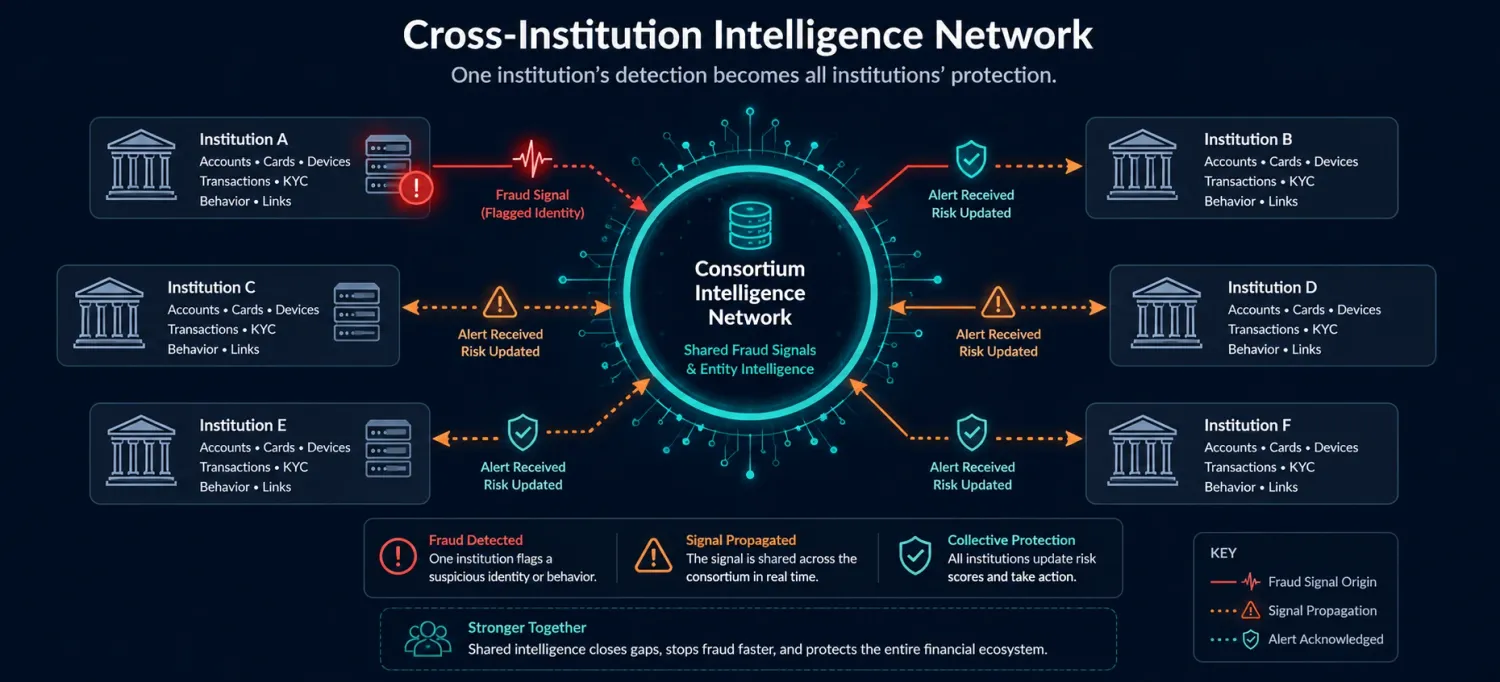
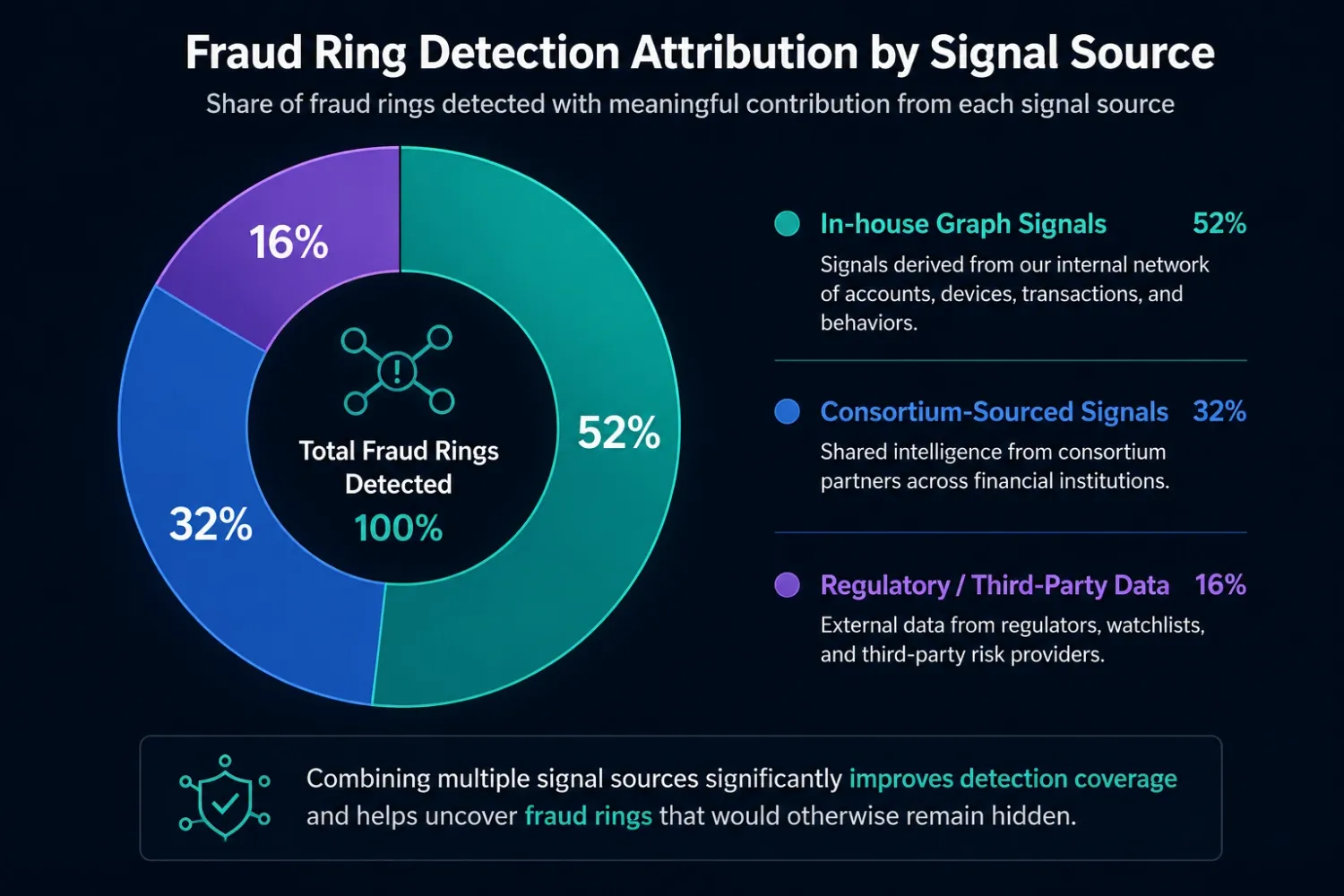
Research on consortium fraud network effects (LexisNexis Risk Solutions / EWS published data) suggests that cross-institution signal sharing improves synthetic identity ring detection rates meaningfully over siloed institutional detection - the improvement is most pronounced at the application stage, before any bust-out has occurred, because consortium signals surface ring infrastructure that pre-dates any single institution's relationship with the synthetic identity.
Vendor consortium networks work the same way, drawing on their installed customer base rather than regulated institution membership:
Sardine fuses device intelligence, behavioral biometrics, and network signals across its customer base - a fintech and neobank-heavy network - giving members visibility into device and behavioral patterns that have appeared in fraud context at other Sardine clients, without raw data sharing.
Sift operates a global fraud network spanning 35,000+ sites and applications, contributing transaction and behavioral signals to a shared model that scores new events against patterns observed across the full network.
Unit21 provides a fraud operations platform with consortium-style case sharing features, allowing compliance teams to flag identity and device patterns for cross-institution review within configured sharing groups.
Stripe Radar scores transactions against patterns observed across the entire Stripe merchant network, giving Stripe-native businesses access to consortium-level intelligence without a separate vendor integration.
📜 Regulatory Context for Data Sharing
Cross-institution fraud signal sharing operates inside a specific regulatory framework. Getting it wrong creates liability; understanding the framework creates competitive advantage.
BSA Section 314(b) is the primary safe harbor for voluntary fraud and AML signal sharing between U.S. financial institutions. Institutions that register with FinCEN under 314(b) can share information about accounts, transactions, and individuals suspected of money laundering or terrorism financing - and the safe harbor has been interpreted to cover synthetic identity fraud signals in anti-fraud contexts. Registration is free and registration status is searchable, meaning your institution can verify that a counterpart is registered before sharing.
The 314(b) safe harbor has meaningful scope limits. It covers sharing between registered financial institutions; it doesn't extend to sharing with non-bank third parties (including most fraud vendors) without additional contractual and legal structuring. Institutions that route signals through a vendor consortium need to ensure that vendor's data handling satisfies Gramm-Leach-Bliley Act (GLBA) requirements for non-public personal information (NPI).CFPB guidance on identity data establishes consumer protection requirements around how identity information is collected, used, and shared in credit decisioning contexts. For fraud detection specifically, the relevant considerations are adverse action notice requirements under the Fair Credit Reporting Act (FCRA): if a fraud signal from a consortium source contributes to a credit denial or adverse action, the institution may have disclosure obligations regarding that signal's source. Legal review of consortium data use in decisioning workflows is standard practice at institutions operating under CFPB supervision.
Emerging identity standards are adding a device trust layer to cross-institution intelligence:
FIDO Alliance device attestation provides a cryptographically verified device identity that can be shared across institutions without exposing underlying device data, enabling cross-institution device reputation without the privacy overhead of raw fingerprint sharing.
FS-ISAC threat intelligence feeds publish anonymized indicators of compromise associated with fraud ring infrastructure - IP ranges, ASNs, domain patterns, device clustering signatures - that member institutions can ingest directly into their fraud graph as high-confidence risk signals.
Cross-institution fraud sharing is legally permissible for fraud prevention when structured correctly - the constraints are mostly procedural (registration, contractual frameworks, disclosure obligations) rather than substantive prohibitions. Institutions that treat compliance friction as a reason not to share are leaving detection capability on the table that their peers are already using.
🛡️ Implementing a Network Fraud Detection System - Architecture and Vendor Landscape
A graph-based fraud stack is four decisions stacked on top of each other: what data you ingest and how fast, how you construct and maintain the entity graph, which detection models run against it, and how analysts work with the output. Get one layer wrong and it degrades everything downstream. A well-tuned GNN on a poorly constructed graph produces noise. A well-built graph feeding a batch-only scoring pipeline misses the bust-out window. The build-vs-buy question runs through all four layers at once.
🛠️ Build vs. Buy - Picking the Right Stack for Your Threat Profile
The right call depends on transaction volume, in-house ML capability, consortium access requirements, and how much of the fraud stack you need to own for regulatory or competitive reasons.
Build makes sense for institutions with in-house graph ML teams, proprietary data advantages, or compliance requirements that restrict third-party data processing. A built stack typically combines:
Graph database: Neo4j (best developer ecosystem, Cypher query language), TigerGraph (higher throughput for very large graphs, GSQL), or Amazon Neptune (managed, integrates with AWS data pipeline stack)
GNN framework: PyTorch Geometric (PyG) for research-to-production flexibility; Deep Graph Library (DGL) for multi-framework support and large heterogeneous graphs
Streaming layer: Apache Kafka for event ingestion and partitioning; Apache Flink for stateful real-time feature computation and graph state updates
Orchestration: Kubernetes for model serving; MLflow or Weights & Biases for experiment tracking and model versioning
Build timelines for a production-grade graph fraud stack at a mid-size institution typically run 9 to 18 months to first meaningful ring detection, with ongoing ML team commitment for model retraining and graph schema evolution. That's not an argument against building - it's a planning input that teams routinely underestimate.
Buy is the faster path to graph-based detection for fintechs, neobanks, and institutions without dedicated graph ML capability. Vendor platforms absorb the infrastructure and modeling complexity, and more importantly, they arrive with pre-built consortium networks that a built stack cannot replicate without years of data-sharing agreements.
Hybrid is the architecture most large institutions land on eventually: an internal graph built on proprietary transaction and identity data, enriched at query time with consortium signals from a vendor or industry network. The internal graph captures what only the institution can see; the consortium layer surfaces ring behavior that extends beyond its own portfolio.
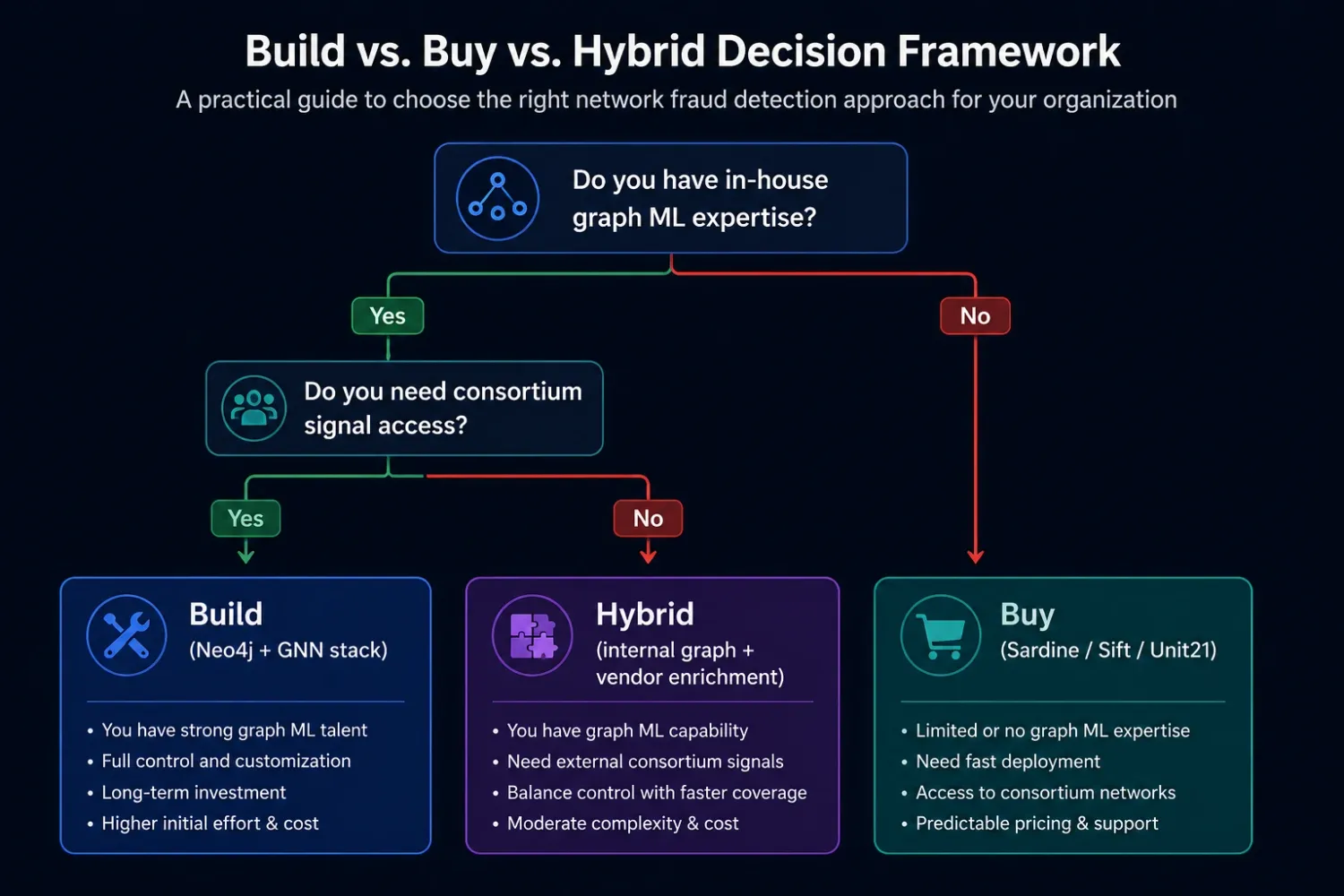
| Path | Best For | Primary Advantage | Key Trade-off |
|---|---|---|---|
| Build | Large FIs with graph ML teams, strict data residency | Full control, proprietary data moat | 9-18 month time-to-value; ongoing staffing cost |
| Buy | Fintechs, neobanks, institutions without ML teams | Consortium network access; fast deployment | Limited customization; vendor dependency |
| Hybrid | Mid-to-large institutions with some internal capability | Internal data advantage + consortium coverage | Integration complexity; dual governance overhead |
📈 Key Evaluation Criteria for Fraud Detection Vendors
Standard procurement checklists - pricing, support SLA, integration options - miss the dimensions that actually determine detection effectiveness. Five criteria separate vendors with real graph fraud capability from those with graph-flavored marketing:
Real-time graph query latency The vendor should be able to state a specific p99 latency SLA for graph query resolution under production load - and that number should be under 100ms for transaction-time fraud scoring. Vendors that cannot provide a latency SLA, or who only offer batch graph scoring, are not solving the bust-out window problem. Ask for latency benchmarks at your anticipated transaction volume, not the vendor's largest customer's volume.
Soft-link detection capability Hard-link detection (shared SSN, email, phone) is table stakes. The differentiated capability is soft-link detection: device fingerprint clustering, behavioral timing correlation, IP proximity analysis, and session telemetry fusion. Ask the vendor to demonstrate a specific case where a fraud ring was detected through soft links only - no shared PII - and walk through the signal path. Vendors without a clear answer to that question are rule engines with a graph wrapper.
Consortium network size and cross-industry coverage A consortium network's value scales with coverage. Key questions: How many member institutions contribute signals? What industries are represented (card issuers only, or also auto, personal loan, BNPL, crypto)? What is the average time between a fraud event occurring at one member and that signal being available to other members? Cross-industry coverage matters for synthetic identity rings, which routinely operate across card, auto, and personal loan simultaneously.
Explainability output for SAR filing When a fraud team files a Suspicious Activity Report, they need to describe the basis for the flag in narrative form. A black-box ring score is not a SAR narrative. Evaluate whether the vendor's explainability output identifies the specific graph path (account A → device X → account B), the signal types that drove the score (hard link vs. soft link, specific edge types), and the confidence level of each connection. GNNExplainer-style attention visualizations are useful for analyst review; they need to translate into plain-language narrative for regulatory filing.
Model governance and drift monitoring Fraud patterns shift. A GNN trained on 2023 ring behavior will degrade on 2025 generative-AI-assisted synthetic identities. The vendor should be able to demonstrate: how frequently models are retrained, how concept drift is detected and measured, what the process is for incorporating new fraud typologies, and whether clients receive transparency into model version changes that affect their scoring. Vendors who treat model updates as invisible background processes create unacceptable compliance and operational risk.
📑 Compliance and Security Architecture Considerations
Graph-based fraud systems link SSNs, device fingerprints, transaction histories, and behavioral biometrics across a data structure that explicitly connects individuals to one another. The compliance architecture around that graph requires more deliberate design than a conventional fraud database - and more surface area to get wrong.
PII in graph nodes - tokenization requirements
Storing raw PII (SSN, full name, date of birth) as graph node properties creates data residency, breach, and regulatory exposure. Production fraud graphs should store tokenized or hashed representations of identity elements, with the token-to-PII mapping held in a separately secured lookup service. Graph queries operate on tokens; raw PII is resolved only at the point of human analyst review, with access logged.
Under GDPR's right to erasure, a graph node linked to a data subject's identity must be deletable or anonymizable on request - which is technically complex in a graph where that node's edges carry fraud signal value. Standard approaches use pseudonymization at the node level (replacing PII with a persistent token that can be invalidated) rather than hard deletion, preserving graph structure while severing the identity linkage.
CCPA creates similar obligations for California residents, with additional requirements around disclosure of data sharing for business purposes - relevant if consortium signals involve California consumer data.
SOC 2 Type II and PCI-DSS
Fraud graph infrastructure that processes payment card data falls under PCI-DSS scope. Key implications: graph databases containing card numbers or primary account numbers (PANs) require tokenization or truncation; access controls must follow least-privilege principles with MFA for administrative graph access; query logs must be retained per PCI audit requirements.
SOC 2 Type II certification - specifically the Security and Availability trust service criteria - is the baseline expectation for any vendor handling fraud graph data. The Type II designation (as opposed to Type I) requires that controls be tested over an observation period, not just documented. Vendor SOC 2 reports should be reviewed annually, with particular attention to any exceptions noted by the auditor.
EU AI Act - model explainability for high-risk financial systems
The EU AI Act classifies AI systems used in credit scoring and fraud detection for financial services as high-risk systems, subject to conformity assessment requirements, technical documentation obligations, and human oversight mandates that take effect for general-purpose AI systems from August 2026 onward (EU AI Act implementation timeline). For institutions operating in the EU or processing EU resident data, this means:
GNN models used in fraud decisioning require technical documentation of training data, model architecture, performance metrics, and known limitations
Decisions that adversely affect individuals (fraud blocks, account restrictions) must be explainable at the individual decision level - attention-weight outputs from GNNExplainer satisfy this for graph-based systems when properly surfaced to analysts
Human review must be available for high-stakes automated decisions; fully automated ring-based account closures without analyst review create EU AI Act compliance exposure
The overhead is real. Institutions building or procuring graph fraud systems should design for explainability, documentation, and human-in-the-loop review from the start - retrofitting those requirements onto a deployed GNN stack costs significantly more than building them in initially.
✨ Benefits, Limitations, and the Road Ahead for Network-Based Fraud Detection
Network-based fraud detection isn't a complete solution on its own - no fraud system is. But it's the only architectural approach that scores fraud the way fraud rings actually operate: as connected networks, not isolated individuals. Fraud rings are defined by shared infrastructure. Graph-based detection reads shared infrastructure. That fit is what makes the capability worth the implementation cost. The question for any fraud team isn't whether graph-based detection outperforms rule-based systems on ring detection benchmarks - it does. The question is whether the benefits justify the complexity at your scale and threat profile.
✅ Benefits
Detects coordinated fraud invisible to point-in-time scoring. A rule engine and a traditional ML model both evaluate entities in isolation. A graph-based system evaluates relationships - and synthetic identity rings are defined by their relationships. Device shared across 30 accounts, SSN cycling across 15 profiles, application timestamps clustering inside a six-hour window: none of these signals exist at the individual-account level. All of them are first-class features in a fraud graph. For coordinated ring attacks, graph-based detection isn't incrementally better than alternatives - it's detecting a different class of signal entirely.
Reduces false positives through relationship context. Individual-account ML models flag anomalies without knowing whether those anomalies occur in the context of a connected fraud ring or an isolated edge case. Graph context resolves ambiguity: a high-velocity cash advance from a new device looks different when the account sits in a clean, unconnected neighborhood of the graph versus when it shares a device with six flagged accounts. Relationship context reduces the false positive rate on individual-account signals because the graph can distinguish structural risk from behavioral noise.
Scales to real-time at enterprise transaction volumes. Graph query latency and GNN inference latency have both dropped significantly as graph database technology has matured. Production deployments at major card networks and payment processors now run sub-100ms graph scoring at transaction scale, with precomputed node embedding strategies pushing latency into the tens of milliseconds for common query patterns. Real-time is no longer a theoretical capability for graph-based fraud detection - it's the standard operating mode for production systems built on TigerGraph, Neo4j's Aura enterprise tier, or Amazon Neptune with appropriate caching architecture.
Supports regulatory explainability for SARs and compliance workflows. Graph-based detection produces an auditable evidence chain: account A connected to device X, device X linked to accounts B through G, accounts B through G sharing an SSN with confirmed fraud account H. That path is documentable, reviewable, and translatable into SAR narrative without requiring a model interpretability specialist. The explainability that regulators and compliance teams need for adverse action documentation is structurally present in graph output in a way that black-box ML scores are not.
⚠️ Limitations
| Limitation | Nature | Mitigation |
|---|---|---|
| High implementation complexity | Operational | Vendor platform or phased build; hybrid architecture to reduce initial scope. |
| Cold-start on thin graphs | Structural | Rule-based or traditional ML scoring at onboarding; graph scoring applied as edges accumulate. |
| Adversarial ring countermeasures | Adversarial | Soft-link and behavioral signal layers that are harder to spoof than structural graph edges. |
| Data residency and PII compliance overhead | Regulatory | Tokenization at graph node level; pseudonymization strategy; legal review of consortium data flows. |
The cold-start and adversarial limitations deserve more than a table entry.
Cold-start is not a temporary problem that disappears after deployment - it's a persistent constraint at the boundary of the graph. Every new account application is a new node with no edges. The fraud risk at onboarding is highest precisely when the graph has the least information. Teams that deploy GNN-only scoring at onboarding discover this quickly. The standard mitigation is a layered scoring architecture: traditional ML or rule-based scoring at account opening, with graph-based scoring applied progressively as the new account accumulates device linkages, transaction edges, and PII co-occurrence with existing nodes.
Adversarial countermeasures are real and evolving. Sophisticated fraud operations that probe detection systems - submitting test applications to observe which patterns trigger reviews - will eventually identify which graph connections generate flags and adapt their infrastructure to avoid them. Graph poisoning (deliberately creating legitimate-looking connections to high-centrality nodes to dilute fraud signal propagation) has been demonstrated in academic settings [needs source]. The operational response is layering behavioral and soft-link signals that are structurally harder to spoof than edge patterns - a ring can avoid sharing an exact device fingerprint across accounts, but it cannot easily make 200 automated sessions look statistically indistinguishable from 200 human sessions.
📈 Where the Field Is Heading (2025–2027)?
Three forces are reshaping the network fraud detection landscape over the next two years, and they're pulling in opposite directions - one raising attacker capability, two raising detection capability.
Generative AI is industrializing synthetic identity creation. What previously required a fraud operation to manually assemble and test synthetic profiles can now be automated at scale: LLM-assisted PII generation, diffusion-model-generated identity documents, voice synthesis for call-center verification bypass. The effect isn't that generative AI makes synthetic identities undetectable - it's that it dramatically lowers the cost of producing them, which raises the volume and velocity of ring activity. Fraud teams should expect the volume of synthetic identity ring activity to increase meaningfully through 2026, with individual ring sizes growing as fabrication costs fall.
Federated GNNs are making cross-institution learning practical without raw data sharing. The privacy constraint that has limited consortium fraud intelligence - institutions cannot share customer data, so shared models have limited signal - is being partially resolved by federated learning architectures that train GNNs locally at each institution and share only gradient updates with a central aggregator. The resulting shared model learns from fraud patterns distributed across the entire network without centralizing any institution's customer data. Several major financial data consortiums are in pilot or early production with federated GNN approaches; the capability is likely to become standard infrastructure for large institutions over the next 18 to 24 months.
Real-time foundation models are entering fraud scoring. Large language models adapted for financial fraud detection - trained on transaction sequences, application narratives, and behavioral telemetry rather than text - are showing early promise for anomaly detection tasks where labeled fraud data is scarce. The architecture is different from GNNs: rather than modeling graph structure, these models learn sequence representations of account behavior and flag deviations from learned normal patterns. For synthetic identity detection specifically, LLM-based sequence scoring is being evaluated as a complement to graph-based ring detection, covering the cold-start gap where the graph has insufficient edges to score reliably.
Neuromorphic graph processing remains further out but directionally significant. Neuromorphic chips - processors that mimic biological neural network architecture - can execute graph traversal and message-passing operations at power consumption levels and latencies that conventional GPU-based GNN inference cannot approach. NVIDIA's ongoing research into neuromorphic computing for financial applications suggests sub-millisecond graph scoring at national payment rail scale within the 2027–2029 timeframe, which would eliminate the latency trade-off that currently forces production teams to choose between real-time scoring accuracy and computational cost.

The net trajectory is an arms race with asymmetric tools on each side. Fraud rings will get cheaper to run and larger in scale. Detection systems will get more structurally aware, faster, and better at sharing intelligence across institutional boundaries. For fraud teams building or evaluating detection architecture today, the relevant question isn't whether graph-based systems will still be relevant in 2027 - they will be, in more capable forms. The question is whether your current stack will still be able to read the graph that attackers are building against you.
⁉️ Frequently Asked Questions
What is a network-based fraud detection system?
A system that models relationships between accounts, devices, identities, and transactions as a graph, then uses graph algorithms or neural networks to detect coordinated fraud patterns invisible to individual-level scoring.
How do synthetic identity fraud rings avoid detection?
Each synthetic identity is designed to pass individual KYC and credit checks independently. Rings exploit siloed detection systems by keeping each node's behavior below alert thresholds while coordinating bust-out activity across the ring as a whole.
What is PII tumbling in synthetic identity fraud?
PII tumbling is the technique of mixing and matching legitimate identity elements (such as a real SSN with a fabricated name or DOB) to create synthetic profiles that pass bureau-based verification checks.
Can small fintechs implement graph-based fraud detection without a dedicated ML team?
Yes - vendor platforms such as Sardine, Sift, and Unit21 provide pre-built graph scoring and consortium signals via API, enabling fintechs to access network-level detection without building custom GNN infrastructure.
What regulations govern cross-institution fraud data sharing?
In the U.S., BSA Section 314(b) provides a safe harbor for voluntary fraud and AML signal sharing between financial institutions. CFPB and OCC guidance further define permissible identity data use in fraud prevention workflows.
🎯 Conclusion
Synthetic identity rings are not a tuning problem; they are an architectural one. By design, these operations exploit the structural blind spots of legacy, point-in-time scoring systems, meticulously keeping each synthetic identity below standard risk thresholds until the final coordinated bust-out event.
Defending against this multi-billion-dollar threat requires matching the adversary's structure. Network-based fraud detection-powered by property graphs, Graph Neural Networks (GNNs), and shared intelligence - is the only defense mechanism native to how fraud rings actually operate.
Key Takeaways for Modern Fraud Architecture:
Move Beyond Individual Scoring: Transition from siloed account evaluation to relationship-based graph analysis. Network-based systems expose the shared infrastructure - such as device fingerprint reuse, IP subnets, and rotating PII-that rings rely on to scale.
Prioritize Real-Time Streaming: Batch processing guarantees you will miss the critical 4 to 8-hour bust-out execution window. Implement event-driven streaming architectures to update graph states and score cross-channel anomalies in milliseconds.
Leverage Cross-Institution Intelligence: Rings deliberately spread their exposure across multiple lenders to avoid concentration alerts. Tapping into consortium networks and 314(b) sharing frameworks closes this gap, making the entire operation visible across the financial ecosystem.
Evaluate the Build vs. Buy Equation: You do not necessarily need an in-house graph ML engineering team to achieve network-level defense. Modern vendor platforms drastically lower the barrier to entry for fintechs and neobanks by providing pre-built graph infrastructure and immediate access to cross-industry consortium signals.
Next Steps to Secure Your Platform
The tools to dismantle synthetic identity rings exist today, but implementing them requires a deliberate shift in how your risk engine handles data.
Assess your capabilities: Download the Fraud Signal Architecture & GNN Readiness Checklist to identify critical gaps in your real-time processing and soft-link detection workflows.
See the network effect in action: Book a technical demo with leading consortium platforms like Sardine, Sift, or Unit21 to discover how shared intelligence and graph databases surface the coordinated attacks that your isolated models are currently missing.
📖 Recommended Blogs
Discover the best deals, trending products, and must-have finds.
Categories
Solutions
Smart Solutions Powered by Tools We Trust
Recommended Solutions to Simplify Your Everyday Needs
Handpicked Solutions Backed by Real Results